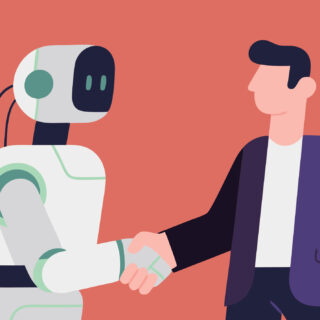

Generative AI has become a new creative partner in nearly every industry. These language-learning models and image creators can brainstorm ideas, polish writing, and generate full campaigns in minutes. For marketers, designers, and writers, it’s an exhilarating shortcut—and a potential trap. Because while AI has made it easy to produce good content, it may also make it harder to produce genuinely new content.
The creative process has always balanced intuition and influence, but generative AI has tilted that balance in ways no one fully anticipated. Up until now, most creative tools have been ones of execution, aiding creators in realizing their ideas. In the case of generative AI, these tools, mathematical algorithms, play a role in the actual ideation. Generative AI’s role in creativity is undeniably powerful. It acts as a brainstorm generator, providing different starting points that can loosen even the most stubborn creative paralysis. A single prompt can make a dozen campaign ideas that you can work on. Generative AI certainly raises the floor, helping more creators reach “good,” yet risks lowering the ceiling by pulling all those ideas toward a shared median1.
The Upside: Generative AI as a Creative Amplifier

The near-term benefits of AI are undeniable. Five key opportunities stand out to us.
First, it promotes divergent thinking. When the most challenging part is starting, Generative AI offers dozens of possible openings—each one a springboard for something new. Research has shown that when writers have access to five AI-generated ideas instead of one, their work improves measurably: novelty increases by 8%, usefulness by 9%, and overall quality rises across the board2. In short, more seeds mean more branches on the creative tree.
Second, it challenges expertise bias. Even the most successful creative professionals can occasionally struggle to overcome the biases of their own experiences. AI can shake that loose by surfacing combinations we’d never think to make. It’s beneficial in early phases, when weird is welcome.
Third, AI assists with evaluation in ways that directly align with designers’ needs. Recent synthesis research in graphic design identifies an “AI-enhanced visual attention and emotional response modeling” paradigm3 that predicts what viewers will notice first and how they’re likely to feel—letting teams rank concepts for novelty, feasibility, salience, and emotional impact before committing production time. In practice, that means faster, more evidence-based critiques: attention maps validate the hierarchy; sentiment models flag where tone falls short.
Fourth, AI meaningfully supports refinement and synthesis. The same review catalogs toolchains that merge variants into coherent drafts, auto-balance layouts, and propose color/type systems aligned to brand semantics—functioning like a tireless finishing editor that tightens copy, clarifies structure, and smooths rhythm. Designers remain in charge of taste and intent; AI compresses iteration cycles, allowing them to spend more time on composition, narrative, and craft.
And finally, Generative AI facilitates collaboration. The creative process has always been social, and at Able&Co., we find it most effective when multiple participants are involved. AI significantly reduces the cost of co-creation. Creators can bounce ideas off a program. The agency only has to bill time for one creative, rather than for every member of a collaborative team, cutting costs in half at a minimum. Designers can co-build with writers, designers, clients, or even customers in real-time—using prompts to visualize ideas that once required entire creative teams to mock up.
The Downside: Smart Tools Breeding Same-Think

For every advantage generative AI tools bring to a team, there’s a potential cost to its creative integrity. When too many people start with the same tool, the differentiations in the outputs begin to collapse in on themselves. At Able&Co., we’ve seen the problems caused by an emerging problem known as “model collapse.” As AI systems increasingly train on AI-generated content, their outputs lose contrast and originality. Like photocopies of photocopies, AI can unintentionally anchor ideas, causing creators to orbit the first generated concept instead of venturing further. In a Wharton reanalysis4 of creativity experiments, ChatGPT improved individual idea quality but significantly reduced diversity—only 6% of AI-assisted ideas were unique, compared to 100% in human-only groups.
The first pitfall is anchoring. Language learning models and image generators are programmed to have certain biases. When a model creates the starting point for a project, creators tend to build upon that idea, branch off from it, and remain within the same realm of bias, resulting in the similarities of AI art becoming apparent.
Then there’s collective sameness. In a vacuum, AI work can look pretty good. When compared to everything that’s out there, you can’t help but notice reduced variance across the field. When everyone relies on the same prompts and models, creative industries risk becoming echo chambers of statistically likely ideas.
Next comes ownership and ethics. Who really “owns” an AI-generated concept? Readers and clients already apply a kind of ownership penalty when they know AI helped. And as lawsuits over training data—from comedians like Sarah Silverman and companies like Getty Images5—move through the courts, attribution, disclosure, and royalties are only getting murkier.
For top creators, ceiling effects pose an additional challenge. Studies show that while developing creators gain the most from AI, experts gain little or even plateau. Overuse of AI can subtly erode the edge that makes their perspective distinct.
Finally, there’s dependency. The creative economy is rapidly building on fragile foundations. Some analysts have called today’s AI boom the biggest speculative bubble in tech history—valuations inflated by circular financing between chipmakers, data centers, and AI labs. If a major player like OpenAI were to go under as a business, the ripple effects would be immediate, with broken automations, lost assets, and creative pipelines grinding to a halt.
Who Benefits Most

Not all creators experience AI the same way. Research reveals a “leveling effect.” People who start with lower creative baselines see the most significant gains—often closing the gap with their more seasoned peers. In controlled studies, those writers improved 10–11% in creativity and up to 26% in quality and enjoyment scores after using AI prompts.
This pattern is echoed in design: automation and assistance, through generation of layout, color semantics, attention prediction, accelerate early proficiency and widen access, but heavy reliance can standardize outputs and erode distinctiveness, especially when models are trained on model-generated work and can “collapse6.”
That’s a profound shift. For decades, access to excellent creative output depended on training, time, and mentorship. Now, AI can fast-track early skill development, making creative expression more inclusive. But the inverse is also true: the more we rely on AI to equalize, the more we risk standardizing and experiencing creative atrophy7. The challenge for leaders is to design systems that expand participation without compromising originality through AI.
Best Practices For Using AI

You should view AI as an assistant, author, editor, and companion—not as a sole creative mind. It can help us explore possibilities more quickly, refine our execution, and reveal patterns that we might overlook, but it cannot replicate intent, empathy, or vision. The most impactful ideas still begin and end with people. When we only use AI to enhance our processes, we preserve what makes creativity human while embracing the tools that make it more powerful.
Good guardrails help ensure Generative AI enhances creativity without replacing what makes it human. Use AI with discipline, transparency, and intent. Generate multiple ideas and blend unexpected ones to push the boundaries of originality. Avoid anchoring—review the first AI draft once, then rewrite from memory before refining. If everything looks alike, start again.
The difference between automation and artistry is intent—and that’s something only people can bring. When we treat AI as a collaborator rather than the creator, we keep humanity at the heart of innovation and elevate creative outcomes.
The Human Future of Creativity
No matter how advanced the tools become, creativity remains a fundamentally human act, rooted in intuition, imagination, and an understanding of your situation that only another person can relate to. At Able&Co., we see AI as it should be viewed, a tool just like the Adobe Creative Suite and the home printers that came before it, not a replacement for quality agency work. It can accelerate processes and amplify ideas, but it’s our people who bring them to life. Generative AI should be used to widen your path and propose alternate routes; it should not determine the destination of your creative work.
We are, and always will be, your human-centered creative and strategic partners—using technology with intention, guided by values that keep the human side first in everything we do. If you’re ready to rediscover what human-driven creativity can do for your brand in a world of AI slop, connect with us.
Sources
Sources:
- How Generative AI can augment human creativity. (2023, July 1). Harvard Business Review. https://hbr.org/2023/07/how-generative-ai-can-augment-human-creativity
- Doshi, A. R., & Hauser, O. P. (2024). Generative AI enhances individual creativity but reduces the collective diversity of novel content. Science Advances, 10(28), eadn5290. https://doi.org/10.1126/sciadv.adn5290
- Hong Li, Tao Xue, Aijia Zhang, Xuexing Luo, Lingqi Kong, Guanghui Huang, The application and impact of artificial intelligence technology in graphic design: A critical interpretive synthesis, Heliyon, Volume 10, Issue 21, 2024, E40037, ISSN 2405-8440, https://doi.org/10.1016/j.heliyon.2024.e40037.
- Murray, S. (2025, July 1). Does AI limit our creativity? Knowledge at Wharton. https://knowledge.wharton.upenn.edu/article/does-ai-limit-our-creativity/
- Davis, W. (2023, July 9). Sarah Silverman is suing OpenAI and Meta for copyright infringement. The Verge. https://www.theverge.com/2023/7/9/23788741/sarah-silverman-openai-meta-chatgpt-llama-copyright-infringement-chatbots-artificial-intelligence-ai
- Balancing Human Ingenuity and AI with a Graphic Design Degree. (n.d.). https://www.shawnee.edu/blog/balancing-human-ingenuity-and-ai-with-graphic-design-degree
- Al-Sibai, N. (2025, February 11). Study finds that people who entrust tasks to AI are losing critical thinking skills. Futurism. https://futurism.com/study-ai-critical-thinking